Our Investment in MEIP: From Protocol to Capital Strategy
by YettaS
Oct 17, 2025

We are proud to announce our participation in MEI Pharma (NASDAQ: MEIP), a Digital Asset Treasury vehicle strategically aligned with the Litecoin ecosystem. What makes this opportunity truly exceptional is the direct involvement of Charlie Lee, the creator of Litecoin, who joins as both a lead investor and board member.
This represents a rare instance of protocol founder alignment at the capital markets layer, an architect of crypto monetary infrastructure now helping engineer its institutional expression. Our investment reflects deep conviction in Litecoin’s role as a reserve-grade digital asset and underscores our broader thesis on the convergence of public equities and on-chain financial primitives.
Why DAT Exists
In the early days, crypto innovation was about protocols, consensus, and decentralization. But as adoption matured, so did the need for financial primitives: custody, ETF, credit, capital formation. Just as oil had to be refined into derivatives, or gold into ETFs, crypto needs to be financialized, turned into structures the capital markets can understand, price, and scale.
We first recognized this divergence in early 2024. Despite lackluster retail flows, institutional buying power was surging. BTC spot ETFs saw persistent inflows, and CME’s Bitcoin options OI had overtaken Binance, marking a structural flip in who controls the order book.
That moment led us at Primitive to fundamentally revisit our market map. In an internal review last April, we confronted a clear shift: Tradfi was taking control of the flows, infrastructure, and pricing mechanisms.

DATs are the clearest expression of this trend. They transform crypto from a volatile position into a capital strategy, complete with distribution channels, investor alignment, and market signaling. In doing so, they don’t just bring crypto into tradfi, they elevate it to the level of sovereign assets, with narratives and leverage structures once reserved for oil, gold, and debt.
Why the Premium Persists
DAT represents a new class of financial instrument that bridges crypto with traditional capital markets. For institutional allocators, it offers a structured, compliant way to gain crypto exposure without holding tokens directly. Crucially, DATs can be tailored to meet a wide range of risk-return profiles.
Take MSTR as the archetype: the company has issued a suite of preferred shares STRK, STRF, STRD, and most recently STRC(raised 2.5b, the largest IPO in 2025), each designed for a different investor base.
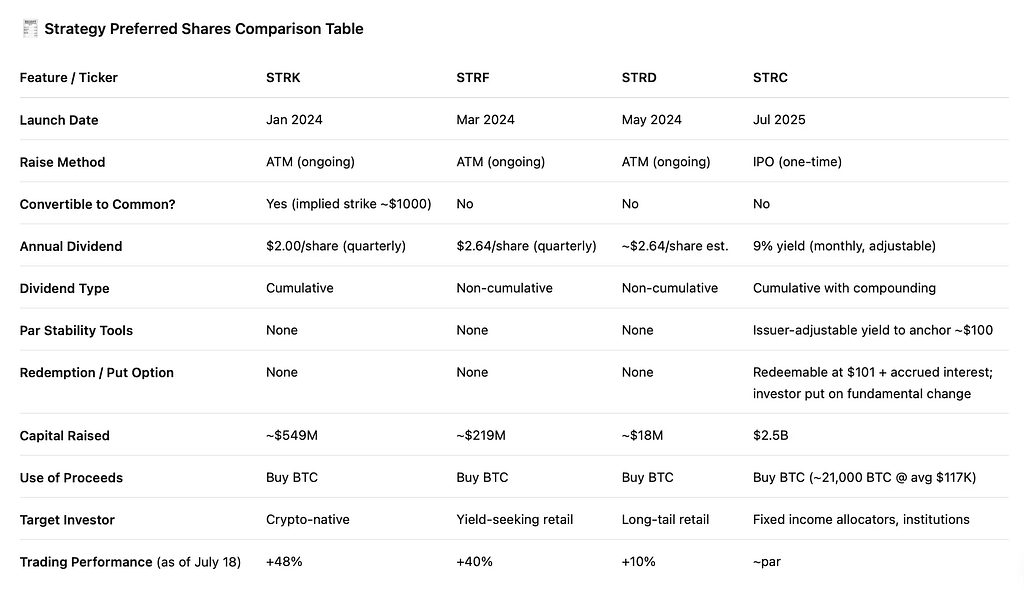

DATs, in this sense, are not just balance sheet plays, they are capital structuring tools. They allow TradFi to underwrite crypto exposure on their own terms.
Besides, if you’re structurally long on a base asset, DATs offer a powerful capital amplifier. When shares trade at a premium to NAV, every new issuance brings in more capital than the intrinsic value of the underlying, allowing the entity to acquire more of the base asset per share. This creates a self-reinforcing flywheel: the more the market believes in the strategy, the more capital the entity raises, and the more aggressively it can accumulate the asset.
What Makes a Crypto Asset Treasury-Grade?
As DATs mature into a new financial architecture, the underlying assets they hold must meet a higher bar. These assets aren’t just lines on a balance sheet, they become the cornerstone of a company’s capital strategy, narrative, and even valuation multiple.
We believe the most suitable treasury assets share the following characteristics:
1. Fundamental Uniqueness and Market Legitimacy
The asset must be structurally differentiated and irreplaceable. Bitcoin, as the digital gold; Ethereum, as the base layer for Stablecoin and RWA; and Litecoin, as the digital silver and most established crypto payment rail, each has carved out a defensible economic role. These assets exhibit:
- Regulatory clarity — preferably designated as commodities, not securities
- High market cap & deep liquidity — for ease of entry and exit at institutional scale
- Technical resilience — a long operational history, zero downtime, and secure consensus
- Decentralization & governance maturity — not beholden to a single entity or founder
- Global recognition & utility — held and used by a broad base of participants
2. Capital Markets Readiness of the Team
Just as important as the asset is the operator behind the treasury vehicle. A capable team, one that is deeply fluent in both capital and crypto markets, can extract nonlinear value from even modest reserves. They can structure equity in ways that enhance narrative, optimize for capital efficiency, and attract the right investor base.
More importantly, they must have conviction, not just in bull markets, but especially in moments of volatility. In downside scenarios, can they stay aligned with the underlying asset and make the hard, correct decisions for long-term compounding?
This was exactly why we backed Joe Lubin’s SBET or Charlie Lee’s MEIP. It wasn’t just about ETH/LTC exposure, it was about backing someone with the foresight and integrity to defend the treasury when it mattered most.
Why Litecoin Belongs on the Treasury Shortlist
Litecoin (LTC), launched in 2011, has survived and evolved through more than a decade of market cycles. It meets nearly every one of the criteria above.
1. Proven Digital Silver
Litecoin is the oldest, most battle-tested blockchain after Bitcoin. Thirteen years of uptime. Zero major bugs. SegWit shipped years before BTC. The network continues to lead on “moneyness” upgrades.
Often dubbed “digital silver,” Litecoin mirrors Bitcoin’s economic design but optimizes for speed and cost: 2.5-minute block times (vs. BTC’s 10), consistently low fees, and high throughput make it better suited for high-frequency payments.
Litecoin’s network activity is clearly accelerating, 2023 and 2024 alone accounted for nearly half of all transactions in its 13-year history. This surge in on-chain usage underscores real-world utility. For corporates, a widely used and reliable network like LTC offers more than just a store of value, it doubles as a payment rail, creating optionality for future treasury deployment and liquidity use cases.

2. Institutional-Ready Ledger
LTC clears on all major rails, with full support across custody, banking, and payments infrastructure. Institutions and retail users alike have taken notice:
- Grayscale’s LTC Trust once traded at the highest premium of any product in their lineup, signaling strong institutional demand. Accumulation resumed in late 2024.
- ETF momentum is strong: Litecoin is currently under active SEC review, and Bloomberg analysts rank it as the third most likely crypto asset, after BTC and ETH, to receive approval.
- Retail adoption leads the industry: The Litecoin Foundation launched an LTC Visa card in 2021, and by 2024, LTC accounted for 37% of all crypto transactions on BitPay, ranking ahead of BTC (24%) and ETH (13%) as the most used crypto in payments.
Together, these signals reinforce Litecoin’s credibility, utility, and readiness as a treasury-grade asset.
3. American-Domiciled, Regulator-Friendly
Litecoin is U.S.-born, U.S.-priced, and U.S.-clean.
- The CFTC has explicitly declared Litecoin a commodity.
- The SEC has never alleged LTC is a security, unlike many high-cap peers
- No token sale, no large founder premine, no ongoing litigation.
This regulatory clarity matters. It eliminates a major risk vector for treasurers: forced divestment. Litecoin is compliant by design — allowing corporates to hold it with confidence.
4. Founder-Aligned and Capital-Savvy
Litecoin Foundation and MEIP are now strategically aligned, one drives ecosystem credibility, the other activates capital. With Charlie Lee, Litecoin’s creator, joining MEIP as a lead investor and board member, this represents rare founder skin-in-the-game at the capital layer.
Charlie Lee, the creator of Litecoin, has demonstrated long-term commitment to the ecosystem, divesting his LTC in 2017 to avoid conflicts and leading key protocol upgrades over the years.
The Litecoin Foundation, which he established as a nonprofit, has driven real-world adoption through initiatives like the LTC Visa card and ATM integrations. Its continued involvement adds depth in custody, policy, and infrastructure, reinforcing institutional standards.
Together, Charlie and the Foundation embody a disciplined, fundamentals-driven approach, positioning Litecoin not just as a passive reserve asset, but as a strategic tool for liquidity and on-chain financial infrastructure.
Closing Thoughts
DATs aren’t just a new narrative, they’re a new capital structure. As traditional allocators warm up to this model, the next generation of MSTR-style plays will be defined not just by what they hold, but by how well they wield capital.
Litecoin is often underestimated, but it checks every box: regulatory clarity, network maturity, real-world usage, and founder alignment. With MEIP, it now has a capital markets engine to match.
We’re long LTC. And we’re backing teams who know how to make it matter.